Agra Ven
Le Morte d'ArthurAgravaine is a brother of Gawaine and a knight of King Arthur’s court whose appearances help trace the widening breach between Launcelot, Queen Guenever, and the king’s fellowship. After the Holy Grail quest, he is named as one of the court’s outspoken observers of Launcelot and Guenever’s renewed attachment; later, he attends the queen’s private dinner, is among the knights who suspect her when Patrise dies from a poisoned apple, and fights against Launcelot in a great clash between Arthur’s knights and Launcelot’s party. These episodes place Agravaine within the court’s movement from rumor and suspicion to open conflict, though the evidence here does not establish his ultimate fate.
Identity and Place at Court
Agravaine is identified as Gawaine’s brother and appears among the knights of the Round Table. The account of the queen’s dinner names him among Gawaine’s brothers alongside Gaheris, Gareth, and Mordred. His connection to Gawaine places him within a prominent family group at court, while his repeated presence in politically charged scenes makes him part of the fellowship’s internal tensions.
The narrative also identifies him as notably outspoken. After Launcelot returns from the Grail quest and resumes visiting Guenever, the relationship attracts notice at court; Agravaine is singled out as particularly vocal in speaking about it. His role is therefore not simply that of a knight who happens to be present. He helps turn a concealed and increasingly dangerous relationship into a matter of public attention.
The Court’s Suspicion of Launcelot and Guenever
After the surviving knights return from the Grail quest, the court rejoices at their homecoming. Launcelot, however, resumes his visits to Guenever and, the narrator says, their love grows stronger than before. He tries to stay away from her at times, explaining that the court is watching them and that Agravaine and Mordred are among those keeping the relationship under scrutiny. Launcelot fears that the scandal will bring shame upon the queen and says that his concern is more for her than for his own safety.
Agravaine thus appears within the account of the lovers’ efforts to conceal their attachment, not as a confidant but as one of the observers whose attention makes concealment harder. The episode does not provide a separate speech or a detailed account of his private intentions. It does, however, connect his outspoken reputation to a courtly climate in which the queen and Launcelot know they are being watched and understand that exposure could have serious consequences.
Patrise’s Death at the Queen’s Dinner
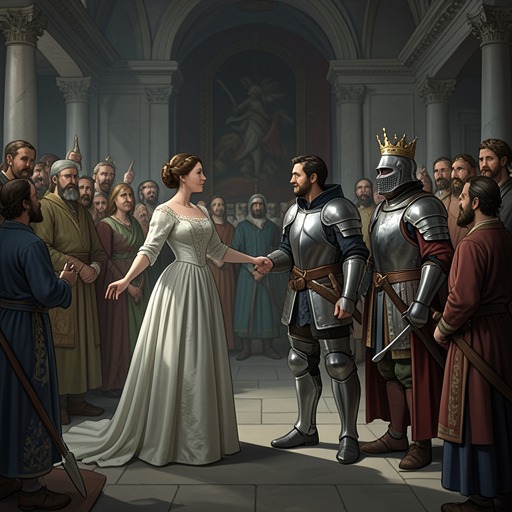
Guenever holds a private dinner in London for twenty-four knights of the Round Table, intending to show that she takes pleasure in the company of the fellowship as a whole, not only in Launcelot. Gawaine and his brothers, including Agravaine, attend, along with Patrise, Mador, and other knights. The account names Pinel as the person who poisons certain apples, intending to kill Gawaine out of hatred connected to Gawaine’s kinship with Lamorak.
The poison does not reach its intended target. Patrise, a knight and Mador’s cousin, eats one of the poisoned apples and dies. Because Guenever has arranged the feast, the assembled knights suspect her. Gawaine points out that the dinner was made for him because his taste for fruit is well known, and warns that the queen may be disgraced by the apparent circumstances. Agravaine is named among those present, but the account does not single him out as the poisoner, as a witness to Pinel’s act, or as the person who makes the accusation. His significance in this episode lies in his place within the company whose suspicion falls on the queen after the death.
Open Conflict with Launcelot
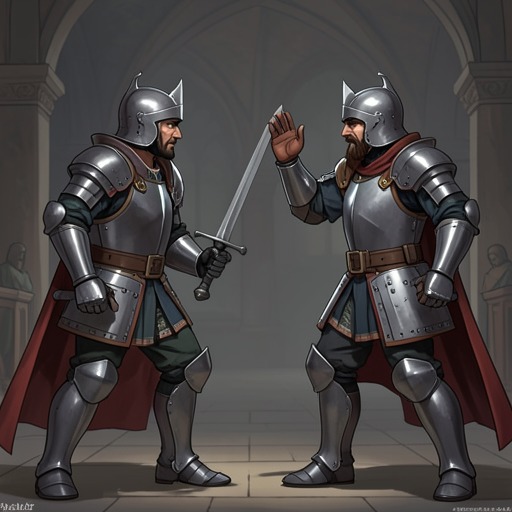
During a later battle, Launcelot and Lavaine ride into the thick of the fighting against knights of Arthur’s court. Launcelot strikes down several of the king’s knights, including Agravaine; after taking another spear, he also brings down Agravaine alongside Gaheris and Mordred. The fighting makes visible how far the court’s divisions have progressed: the tensions surrounding Launcelot and Guenever now belong to a conflict in which knights who share the Round Table stand against one another.
Agravaine’s further encounter with Launcelot comes amid a clash between Launcelot and his own kin. Bors, Ector de Maris, and Lionel join the fighting, not recognizing Launcelot beneath his disguise. Their spears bring him down and Bors wounds him, but Launcelot continues to fight. When he recognizes his opponents’ faces, he refuses to kill them, despite having the advantage. The episode emphasizes the peril of divided loyalties: Agravaine is on the side fighting Launcelot, while Launcelot’s kin also attack him before recognizing him.
Narrative Role and Limits of the Evidence
Across these episodes, Agravaine’s importance lies in the recurring pressure his presence represents within Arthur’s court. He is named among those who speak openly about the lovers, appears at the dinner where suspicion attaches to Guenever, and is later among the knights struck down by Launcelot. Together, these details connect watchfulness, public suspicion, and armed confrontation without making Agravaine the agent of every development.
The evidence does not establish that Agravaine poisoned the apples, that he personally accuses Guenever over Patrise’s death, or what ultimately happens to him. His documented role is narrower and more revealing: he is an outspoken court observer and a participant in the fellowship’s fracture, present as private tensions surrounding the queen and Launcelot become a public and martial crisis.